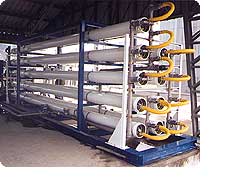
If your water treatment requirements require high quality water with a
minimum of chemical manipulation then a HEI Reverse Osmosis system may
be just what the doctor ordered!
Reverse Osmosis is a process for removing dissolved mineral
salts, organic molecules and certain other impurities by
forcing water under pressure to pass through a semi-permeable
membrane.
HEI industrial Reverse Osmosis systems are appropriate
for applications with flow rates up to a standard size of
500 gpm per module, with modules being combined to provide
even larger flow rates. Single-Pass Reverse Osmosis units
are ideal for most situations, but Double-Pass Reverse Osmosis
units can be provided for those situations where ultra-pure
water is necessary.
The Reverse Osmosis process reverses the natural osmotic
effect in which fluids with a low concentration of dissolved
solids pass through a membrane into an area of higher concentration.
With Reverse Osmosis, water is made to pass from a state
of high concentration to a state of low concentration.
Since Reverse Osmosis does not occur naturally, it must
be created by applying pressure to the high solids water
in order to force it through the membrane, with pressures
from 200 to 400 psig in most applications, 1,000 or even
1,200 psig for sea water desalination and high solids conditions.
The pressure applied to the feed side of the RO membrane
must be much higher than the natural osmotic pressure of
the water in order for the osmotic process to be reversed.
High pressure pumps are used to create the pressure needed
to produce economically acceptable flow rates.

HEI
Reverse Osmosis systems work on the Crossflow Filtration method.
Using this method , which takes the feed water and uses a
percentage of it as a wash or reject stream, the solids are
removed during the filtration process. This extends the life
of the filter membrane.
The product flow of an RO is mainly a function of temperature
and pressure. System recovery (product divided by feed)
is limited by the characteristics of the feed water and
can be controlled through the use of recycle stream. Product
quality is based on a percentage of dissolved solids fed
to the membrane. There should be an economic balance between
product quality and system recovery. High recoveries increase
concentration of dissolved solids in the system which degrades
quality, but high recoveries make the system more efficient
and decrease waste.
RO units do not deliver to service all of the water that
is fed to them. During operation, some of the incoming water
is used to wash down the membrane, and only part becomes
finished product water. Purified water is referred to as
product and wastewater is referred to as concentrate, or
reject. The percent of water delivered as product is called
the recovery, and depends upon the membrane and on total
RO unit design considerations.
RO units are volume rated at 77°F (25°C) incoming
water temperature. Adjustments must be made if the incoming
water temperature varies.
HEI can provide pretreatment of water prior to the RO process
if it is required. Chlorine removal is important but high
hardness minerals should also be controlled by a softener
or other suitable methods of treatment. Hard water scale
build-up impairs RO unit performance. Turbidity, pH, iron,
and other impurities must be controlled for optimum RO performance.
HEI can provide ozone, ultra-violet and chlorination systems
for potable water systems.
 RO
units are often used to provide low solids feed water to
deionizers. This lengthens the deionize service cycle and
lowers regeneration frequency. Considerable money can be
saved through reduction of regenerant chemicals. Systems
engineering of water treatment problems takes on added significance
as RO and DI processes are designed and operated together
as a system.
RO
units are often used to provide low solids feed water to
deionizers. This lengthens the deionize service cycle and
lowers regeneration frequency. Considerable money can be
saved through reduction of regenerant chemicals. Systems
engineering of water treatment problems takes on added significance
as RO and DI processes are designed and operated together
as a system.
HEI builds physical, chemical and biological waste systems
to address treatment of the reject (concentrate), a concern
often overlooked in process design.
This study involves a Double Pass RO system
for high quality turbine engine NOx suppression water at an
electricity generating plant. They saved $500,000 capital
costs over a resin system, and approximately $100,000 yearly
in operating costs. The system is supplying at 75% recovery.
The following photograph shows the major components of
the installed system. From the left can be seen a) the membranes,
b) local control panel, c) 2 upright pumps, d) filter. Behind
is seen the panel room. Not shown but included in this installation
is a carbon filter.












