HEI
Inclined Plate Clarifiers Use Gravity & Innovative Engineering
HEI
Inclined Plate Clarifiers Use Gravity & Innovative Engineering.
A gravity clarifier is the most economical method of removing
solids from liquid because natural gravity is the source
of energy and it is free. A clarifier simply provides a
non-turbulent zone where heavier than liquid solids, suspended
by turbulence, are given sufficient time to settle to a
quiescent surface. The HEI inclined plate clarifiers are
compact units with multiple layers of settling area utilizing
less than 25% of the floor space required by conventional
clarifiers.
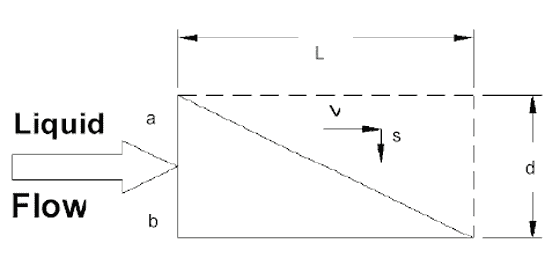
A particle carried forward by the velocity
of the liquid flow must settle at a rate that allows it to
reach the bottom before passing through the clarifier. Thus,
particles beginning at a point "a" must traverse
some route lying between ab and ab' in order to avoid being
carried over the outlet.
If V is the horizontal velocity of the liquid, S the solids
particle vertical settling velocity, L the length of the
settling device, and D its depth, then particles entering
at point A will settle to the bottom of the device only
if V does not exceed: S(L/D)
Since Vmax / S = L / D then, Vmax
= S (L / D)
Therefore, the velocity at which a horizontal clarifying
device may be operated successfully is directly proportional
to its length and inversely proportional to its depth.
 This
analysis applies to multiple horizontal plate units also.
The spacing between plates is usually a few inches as opposed
to a depth of several feet in a horizontal tank; therefore,
"settling-out" times are dramatically reduced.
The flow must be non-turbulent to prevent settled solids
from being reentrained within the moving liquid. Small plate
spacing and a large surface area permits laminar flow at
higher velocities than large horizontal tanks would allow.
This
analysis applies to multiple horizontal plate units also.
The spacing between plates is usually a few inches as opposed
to a depth of several feet in a horizontal tank; therefore,
"settling-out" times are dramatically reduced.
The flow must be non-turbulent to prevent settled solids
from being reentrained within the moving liquid. Small plate
spacing and a large surface area permits laminar flow at
higher velocities than large horizontal tanks would allow.
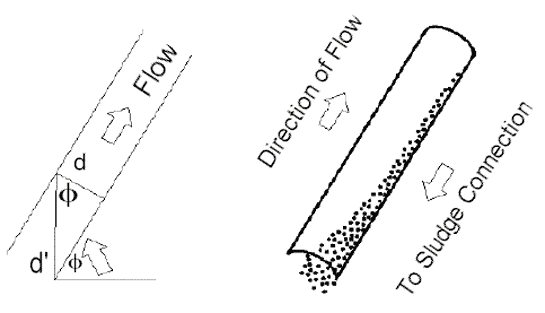
Horizontal clarifying devices become self-flushing if they
are inclined at an angle which exceeds the angle of repose
of the settled solids. In such cases, flow enters the lower
end of the device where settling particles move to the floor
eventually sliding back out the entrance. Clear effluent
leaves the top of the device.
However, when the device is inclined, the furthest settling
particles no longer fall through distance D but some longer
distance D'. This new longer settling distance D' is related
to D by the relation: D = D' cos Ø.
Theta "Ø" is the angle, the device is inclined
to the horizontal plane. Thus settling distance is increased
by the factor: 1/cos Ø In the case where Ø =
60º, 1/cos Ø = 2.
The maxi mum settling distance is twice the distance between
the plates. It is apparent then that the lower the angle
of inclination, the smaller the settling distance. However,
the angle of inclination must exceed the angle of repose
of the solids to be separated. The previous equation may
be modified to express the cosine of an inclined plate clarifying
system as:
Vmax = L / (D / cosØ) (s) = L·cosØ
/ D (s)
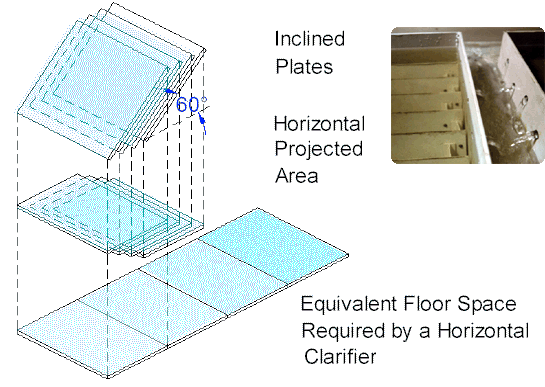
A reduction of the required floor space
is acquired by diminishing the separation between the horizontal
plates to a few inches and stacking the settling surfaces.
Inclining the plates to provide self flushing, 45º for
heavy particles and 60º for light particles, reduces
the available horizontal projected area (effective settling
area) by a factor equivalent to the cosine of the angle. The
surface area diagram (below) graphically compares the floor
space requirements of an HEI inclined plate clarifier with
the equivalent horizontal projected settling area.
The settling rate for a specific solids
should be determined by standard laboratory tests. Light particles,
such as metal hydroxides, usually require a design parameter
of 0.25 gallons per minute per square foot of horizontal projected
area. These low density solids require the inclined plates
to be set at a 60º angle to induce the particles to slide
down the plate. Heavier particles (such as sand that easily
flow) will readily slide from plates set at a 45º angle.
Maximum flow rate of an inclined plate clarifier is based
on the flow rate per unit of a horizontally projected surface
area. Retention time in the clarifier is not a design criteria.
However, attaining optimum performance requires the prudent
design to recognize several additional, very important factors.
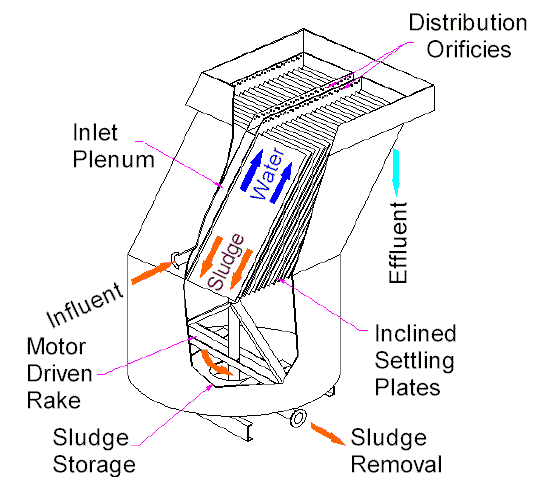
An inlet plenum must be provided to uniformly
distribute the influent to the inclined plate compartments.
Laminar flow must be established as the flow enters the plate
area. The hydraulic momentum of the incoming liquid must be
dissipated to prevent channeling. The HEI design does not
use orifices which may clog with heavy suspended solids.
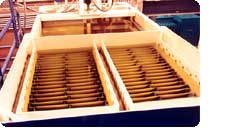
The
outlet area must be designed to force uniform flow from all
plate compartments and also over the entire width of the plates.
For example, wide plates (4 foot and over) with side outlets
do not utilize the center section and must be proportionately
decreased. A poorly designed outlet can result in one 50-60%
plate utilization. The HEI clarifier utilizes an orifice type
weir with orifices placed on each side of the plate to force
uniform flow from each compartment.
The HEI inclined plate clarifier provides
equalized flow between two or more plate packs. After installation,
clarifiers will often settle which creates channeling and
turbulence through one of the plate packs. A prudent design
prohibits channeling.

For
most applications there is insufficient volume below the inclined
plates to provide adequate storage time to attain sludge thickening
or compaction. A secondary tank is required to provide sufficient
storage time to accumulate and thicken the collected solids.
Laboratory studies must be performed on each sludge to determine
thickening rate. Usually sludges must be retained in non-turbulent
condition for 4-24 hours to reach an optimum concentration.
A typical well-flocculated clarifier influent may contain
300-500 ppm suspended solids. The solids will settle to a
volume of approximately 10% of the initial volume (0.3-0.5%).
Hence, a 10% underflow is required to remove the accumulated
solids. The sludge accumulator or sludge thickener must have
the capacity to store the accumulated solids for at least
24 hours. The filter press or other compaction device must
be sufficiently large to continuously compact the collected
solids. Contact your HEI technical representative to assist
you in the sizing of your liquid solids separation and solids
compaction system.
HEI inclined plate clarifiers are constructed
of 1/4" ASTM A36 structural carbon steel. The inclined
plates are fiber reinforced plastic with spacers and brackets
fabricated of 304 stainless steel and polyvinyl chloride plastic.
Units will be fabricated entirely of stainless steel on request.
All carbon steel surfaces are media blasted to SSPC SP-6 finish
and coated on the interior with high build polyester epoxy
and the exterior with acid resistant epoxy. The units will
be coated with FRP on request.
Slant
Plate Clarifier With Inverted Pyramid Bottom |
Slant
Plate Clarifier With Motorized Rake |
Model No. |
Flow Rate |
L |
W |
H |
Dia. of
Equival.
Circular
Clarifier |
Model No. |
Flow Rate |
L |
W |
H |
Dia. of
Equival.
Circular
Clarifier |
110/60/SA |
25 |
8'11" |
5'11" |
11'8" |
12' |
110/60/MA |
25 |
8'11" |
5'7" |
10'5" |
12' |
150/60/SA |
35 |
10'1" |
7'5" |
12'10" |
14' |
150/60/MA |
35 |
10'1" |
7'1" |
10'5" |
14' |
250/60/SA` |
60 |
10'10" |
8'10" |
13'7" |
18' |
250/60/MA |
60 |
11'11" |
9'0" |
10'5" |
18' |
220/60/SB |
55 |
10'3" |
5'11" |
13'10" |
17' |
220/60/MB |
55 |
10'3" |
5'7" |
12'7" |
17' |
300/60/SB |
75 |
11'2" |
7'5" |
15'2" |
20' |
300/60/MB |
75 |
11'2" |
7'1" |
12'7" |
20' |
500/60/SB |
125 |
13'5" |
8'4" |
15'8" |
25' |
500/60/MB |
125 |
13'4" |
9' |
12'7" |
25' |
1000/60/SB |
250 |
14'4" |
11'4" |
18'4" |
35' |
1000/60/MB |
250 |
15'5" |
11' |
12'11" |
35' |
440/60/SC |
110 |
10'11" |
5'11" |
18' |
23' |
440/60/MC |
110 |
10'11" |
5'7" |
16'10" |
23' |
600/60/SC |
150 |
12'7" |
7'5" |
20'2" |
27' |
600/60/MC |
150 |
11'10" |
7'5" |
17' |
27' |
1000/60/SC |
250 |
13'5" |
8'4" |
21' |
36' |
1000/60/MC |
250 |
13'11" |
9' |
19'1" |
36' |
2000/60/SC |
300 |
17'3" |
11'4" |
19'4" |
50' |
2000/60/MC |
300 |
16'10" |
11'1" |
16'6" |
50' |
2900/60/SC |
725 |
19'2" |
11'11" |
23'6" |
60' |
2900/60/MC |
725 |
19'3" |
12'3" |
23' |
60' |
4200/60/SC |
1050 |
22'2" |
16'5" |
23'9" |
73' |
4200/60/MC |
1050 |
22'1" |
15'11" |
21' |
73' |
|
NOTES:
- HEI Model No. (110/60/SA) typically indicates: 110 sq.
ft. horizontal projected area. 60 indicates the angle
of inclination of the plates, "m" indicates
motorized sludge rake, "s" indicates sloped
bottom, A indicates the length of the settling plate,
A is 30" long, B is 60" long, C is 120"
long.
- Flash mix and flocculation sections for 2,000 sq. ft.
and greater size clarifiers are shipped separately.
- Clarifiers supplied with 45° inclined plates will
have 40% more horizontal projected area for the equivalent
outside dimensions.
- Dimensions given are approximate.
- HEI will custom fabricate clarifiers to accommodate
reduced floor space or ceiling heights.
- Dimensions of units having 1,000 sq. ft. or less include
flash floc sections.
Equipment
Specifications: Inclined Plate Clarifier - Rake Bottom
Equipment
Specifications: Inclined Plate Clarifier - Cone Bottom










 There
are essentially only two designs of sludge storage
compartments in general use. The conventional design
is an inverted cone or pyramid with angles to match
the expected angle of repose of the solids to be collected.
There
are essentially only two designs of sludge storage
compartments in general use. The conventional design
is an inverted cone or pyramid with angles to match
the expected angle of repose of the solids to be collected.