 FILTER PRESS OPTIONS
Option Availability Chart
Filter
Press Specifications 1 - 8 Cu. Ft.
Filter Press
Specifications 8 - 20 Cu. Ft.
Filter Press
Specifications 15 - 25 Cu. Ft.
Filter Press
Specifications 15 - 200 Cu. Ft.
HEI Filter
Press Model / Capacity / Filtration area
EFFICIENCY
 The
Hoffland Environmental, Inc. Filter Press is one of the
most efficient means of liquid/solid separation through
pressure filtration; either for solution filtration or sludge
volume reduction. It provides a simple, reliable method
of high compaction pressure to compress and dewater solids
into cakes of 25 - 60% total concentration producing clearer
filtrate solutions than systems which remove only free water.
The
Hoffland Environmental, Inc. Filter Press is one of the
most efficient means of liquid/solid separation through
pressure filtration; either for solution filtration or sludge
volume reduction. It provides a simple, reliable method
of high compaction pressure to compress and dewater solids
into cakes of 25 - 60% total concentration producing clearer
filtrate solutions than systems which remove only free water.
SLUDGE DEWATERING
Slurries of waste water, such as metal hydroxides, alum
sludges, etc., are pumped into the chambers of the filter
press. The filtrate passes through the filter cloth and
the solids are retained. The solids collect on the cloth
forming an excellent filter or if one were to intentionally
pre-coat the cloth. As additional solids are pumped into
the chamber, the solids continue to collect until the entire
chamber is full of dewatered solids. The press must then
be cleaned and recycled.
FILTRATION
 Fluids
such as wine, beer, etc., may be clarified by pumping through
a filter media like diatomaceous earth or cellulose filter
aid. In the case of filtration, the retained solids are
not important. It is the clarity of the filtrate that justifies
the use of the filter press.
Fluids
such as wine, beer, etc., may be clarified by pumping through
a filter media like diatomaceous earth or cellulose filter
aid. In the case of filtration, the retained solids are
not important. It is the clarity of the filtrate that justifies
the use of the filter press.
The filter press produces a recoverable solid such as dye
stuff, or precious metals, or may be used with the intent
of reducing the volume of the waste.
Reducing the volume of waste is very for hazardous materials.
A liquid slurry of hazardous metal hydroxide waste may be
reduced from 40 drums of 1% solids to one drum of 40% solids.
When processing hazardous waste, the filter press may economically
justify itself in less than one month.
TYPICAL APPLICATIONS
- Process Filtration and Plate Washing
- Pharmaceuticals and Chemicals
- Clarification of Processed Fluids
- Municipal Sludge Dewatering
- Reduction of Waste Solids
- Precious Metal Recovery
- Biological Filtration
- Food Processing
- Saline Filtration
OPERATION
Dewatering is accomplished by pumping sludge into chamber
(A) surrounded by filter cloths (B). As pumping pressure
is increased, the filtrate is forced through the accumulated
filter cake (C) and cloth, leaving the chambers full of
solid filter cake.
The chambers in HEI presses are formed by two recessed
plates held together under hydraulic pressure. The hydraulic
ram (D) moves the follower (E) against the stack of filter
plates (F) closing the press. The ram continues to apply
pressure of sufficient force to counteract the high internal
compaction pressures. The head stock (G) and tail stock
(H) are held in place by specially engineered side rail
supports bars (I).
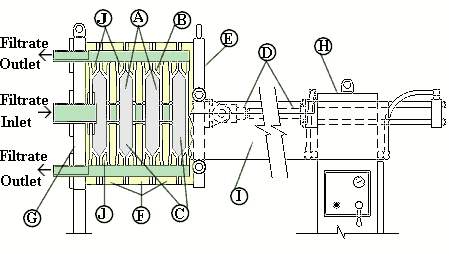
The filtrate passes through the filter cloth and is directed
by channels in the plates and drain ports (J) to the head
stock for discharge. The filtrate typically contains less
than 15 ppm suspended solids.
The filter cake is easily removed by simply reversing the
hydraulic ram, thus opening the press. The lightweight plates
may then be moved apart permitting the compacted cake to
fall from the chamber.
CONSTRUCTION
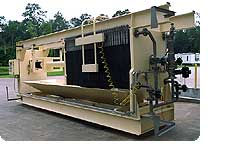 The
HEI Filter Press is constructed of heavy duty steel or stainless
steel designed to withstand up to 225 psig pumping pressure.
The
HEI Filter Press is constructed of heavy duty steel or stainless
steel designed to withstand up to 225 psig pumping pressure.
All structural steel is sand blasted, primed and painted
with corrosion resistant epoxy paint. Internal components
are constructed of high molecular weight heat stabilized
chemical resistant plastic. Areas subject to wear such as
the top of the side rails are covered with corrosion resistant
wear plates.
Hoffland Environmental, Inc. has a custom manufacturing
policy which will tailor a Filter Press for your specific
application.
BENEFITS
HEI Filter Presses are equipped with lightweight, corrosion-resistant
polypropylene filter plates (gasketed, non-gasketed, and
membrane) and can be engineered with an automatic plate
spreader for easy and safe removal of compacted solids.
A self-compensating hydraulic system automatically prevents
decreases in closure pressure due to thermal exposure/contraction
of the chambers between the polypropylene filter plates.
SIZING YOUR HEI FILTER PRESS
 The
HEI Filter Press will compact sludge to a dry cake having
a density that is not only dependent upon the ultimate compaction
pressure, but also the specific characteristics of each
sludge.
The
HEI Filter Press will compact sludge to a dry cake having
a density that is not only dependent upon the ultimate compaction
pressure, but also the specific characteristics of each
sludge.
The chart below gives the average dry weight of three common
sludges. Use the accompanying equation to calculate the
size of your filter press. First determine the quantity
of sludge to be processed per cycle (minimum of 8 hours
per cycle is recommended). Then insert the solids content
(ppm must be divided by 1,000,000 or percent divided by
100), weight per gallon of the liquid in pounds, and pounds
dry weight per cubic foot (from the chart). Complete the
equation to calculate the capacity of the filter press.
The cycle time is dependent upon both the sludge dewatering
characteristics and the solids content. High solids content
dramatically shortens the compaction cycle. Please contact
your HEI representative for recommendations on sludge thickening
equipment.
SLUDGE TYPE |
PERCENT OF CAKE DRY WEIGHT
SOLIDS |
AVERAGE POUNDS DRY WEIGHT
PER CUBIC FOOT |
Biological Sludge |
115 - 25 |
15 |
Metal Hydroxide Sludge |
25 - 40 |
25 |
Lime Treated Sludge |
30 - 60 |
35 |
|












