Separation
of oil from water in industrial waste streams is an initial
step to obtain permit level discharge.
Efficient oil/water
separation is of prime importance in industrial waste treatment
stages often required before final discharge.
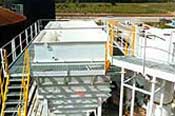
The HEI corrugated plate separator is a sophisticated,
compact, highly efficient gravity settling basin designed
to fill this need.
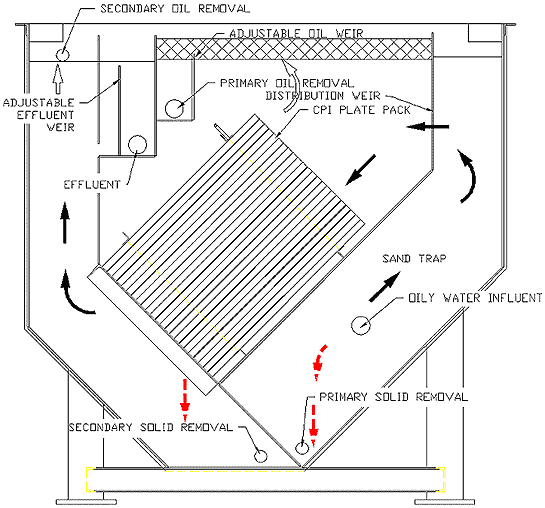
The basic design of the HEI corrugated plate separator
is shown below. When wastewater enters the separator inlet
compartment, the velocity is slowed, allowing large solids
to settle out in the sand collection compartment and large
oil globules to float to the surface. The influent then
passes through a distribution baffle and enters the plate
pack compartment.
 After
passing through a quiescent zone, wastewater enters the
corrugated plate pack. Here the finer oil droplets and settable
solids are separated out by gravity. The de-oiled wastewater
flows into the effluent compartment and rises toward the
effluent weir.
After
passing through a quiescent zone, wastewater enters the
corrugated plate pack. Here the finer oil droplets and settable
solids are separated out by gravity. The de-oiled wastewater
flows into the effluent compartment and rises toward the
effluent weir.
Both the plate pack compartment and effluent compartment
are provided with an adjustable weir. Height is adjusted
to balance the hydraulic loads so that only oil is skimmed
off the surface of the plate pack compartment. An oil layer
is maintained in this compartment and is automatically
skimmed due to the difference in specific gravity of
oil and water.
At the heart of the HEI corrugated plate separator
is the plate pack. The standard plate pack consists of fifty
corrugated plates spaced on 3/4" centers. A cutaway
view is shown below.
The plate pack is designed so that oil, as it separates
from water, migrates to the underside of the plate above
and collects in the peaks of the corrugations. The migration
continues counter to the water flow toward the inlet of
the plate pack. Sludge settles to the top of the
next lower plate, collects in the valleys of the
corrugations, and slides by gravity toward the outlet
end of the plate pack.
The peaks of the corrugations at the inlet end are connected
by vertical gutters to guide the collected oil of of the
wastewater flow area. The same system is provided on the
valleys at the outlet end for sludge disposal. The collection
gutter prevents the re-entrainment of oil or sludge.
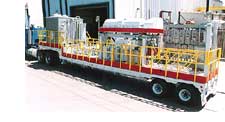
HEI manufactures and sells fabricated steel
vessels housing the corrugated plate pack. Each unit is designed
to customer requirements and specifications.
At Hoffland Environmental.... we design, manufacture and
install every system as though we were going to us it ourselves.
The chart below illustrated the relationship
between capacity, particle size, temperature, and specific
gravity for the HEI corrugated plate separator.
Because the plate pack is a gravity type separator, its
efficiency is determined by the rising or settling velocity
of the smallest particles to be intercepted. The following
sizes may be used as design guidelines.
Runoff or Washdown 90 Micron
Industrial Waste Systems 60 Micron
Produced Water 40-50 Micron
Example: Given an industrial stream of 100 gpm at 68°F;
specific gravity, water = .995; specific gravity, oil =
.895 determine separator size required and actual 100% particle
removal size.
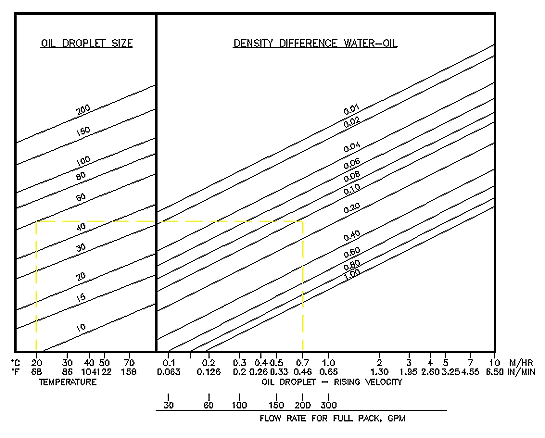
Locate 68°F on the horizontal temperature scale of the
chart below. Project vertically to intercept 60 microns
on the particle size scale. Next, project vertically down
to the through-put scale and read 150 gpm.
This is the maximum flow per pack for 100% 60 micron removal.
Only one pack is needed then for 100 gpm. Now, starting
at 100 gpm project vertically to .1 differential. Next,
project horizontally to the temperature projection (68°F).
Interpolate a micron size of 50.
When operated at the above conditions a single plate pack
unit will remove all free oil particles down to 50 microns.
Equipment Specifications: Oil
Water Separator












